



by Scott M. Haskins, Art Conservator
https://www.FineArtConservationLab.com
Nonsensical for future generations
The Ai art restoration coverage practically wrote itself. “A Game-Changer For Restoration,” announced one outlet, declaring AI was “revolutionizing art conservation, restoring centuries-old, damaged paintings in just hours rather than years.” Another ran “MIT Student Invents Breakthrough Art Restoration Technique.” Artnet asked “Can A.I. Restore a Renaissance Painting?” and helpfully answered its own question in the headline: “Yes.” And this one kills me, CNN simply declared the method “faster and more ethical than manual restoration.”
Hours instead of years. Revolutionary. A breakthrough. Faster and more ethical than the work conservators have refined over a century. You would think someone had figured out how to un-crack five hundred years of dried, lost oil paint by waving a phone at it.
Is AI Restored a Painting Really a Thing?
What actually happened is that a clever graduate student printed a picture onto a sheet of film and laid it on top of the painting. The painting is still cracked. It is cracked underneath that film right now, exactly as cracked as it was before anyone turned on a computer. Nothing was stabilized, preserved or restored. A photograph of a guessing algorithm was placed over the damage. That is the entire trick — and it could be a genuinely interesting piece of engineering for some marketing purposes and educational purpose— but “interesting piece of engineering” does not sell as well as “AI heals masterpiece in an afternoon,” so the second headline is the one that ran.
This is what happens when people who do not practice a profession get to define its words for the public. The reporting reached for the most thrilling verb available, “restore,” because the accurate description — “printed a removable reproduction overlay that leaves the original untouched” — does not make anyone click. The excitement and the accuracy pointed in opposite directions, and the coverage chose excitement every time.
That choice has consequences for anyone with a damaged painting or mural they care about, and correcting the hysterical pronouncements is the reason we’re writing this. If you have questions about a piece of your own, we’re always glad to talk it through on the phone. Scott Haskins, Painting Art Conservator 805 570 4140
What the technique actually does, stripped of the headline
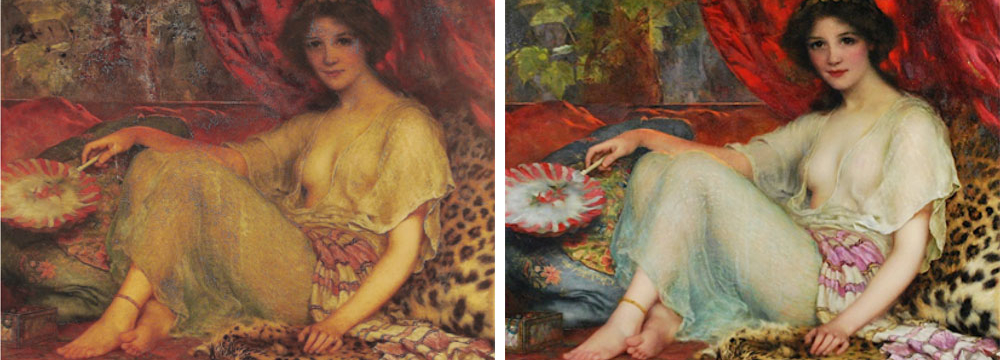
Here is what the MIT graduate student’s method does, without the promotional language. A damaged painting is scanned. Software maps the areas of loss. An AI model generates a digital guess at how those areas might have looked when the painting was new. That generated image is printed onto a clear polymer film, the film is aligned over the painting (but we don’t know what adhesive is used to attach it to the painting) and it is applied with a layer of removable varnish on the painting.
To the researcher’s credit, the method was designed to be transparent about itself. The film is removable. It sits on top of a varnish layer, not on bare original paint. Some areas of the print were intentionally left visible up close so a viewer can tell the overlay from the original. The work was published in a peer-reviewed scientific journal, and the inventor clearly thought about not deceiving anyone. None of our argument here is a knock on the engineering.
The problem I’m commenting on is not the tech (which has important application flaws). The problem is the word the news wrapped around it. Its what the public hears.
When you restore a painting, you work on the painting. When you reproduce a painting, you make a copy and the original sits untouched. This technique makes a copy and places it on top of the original. By any professional standard, that is a presentation tool — a way to show a viewer an approximation of the lost image — not a treatment of the artwork itself. Calling it “restoration” is the same category of mistake as calling a high-quality giclée print of your grandmother’s portrait a “restored painting.” The print might look wonderful. Your grandmother’s actual painting is still in the closet with the water stain.
What restoration actually means — a real case
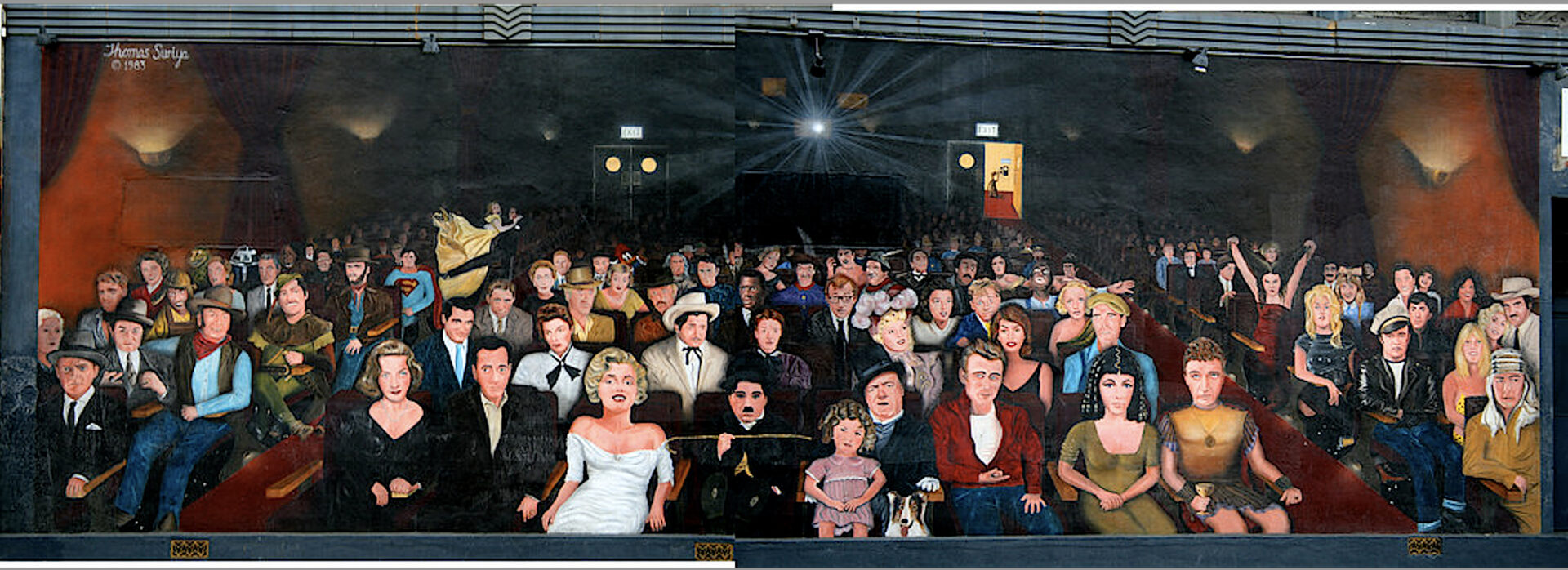
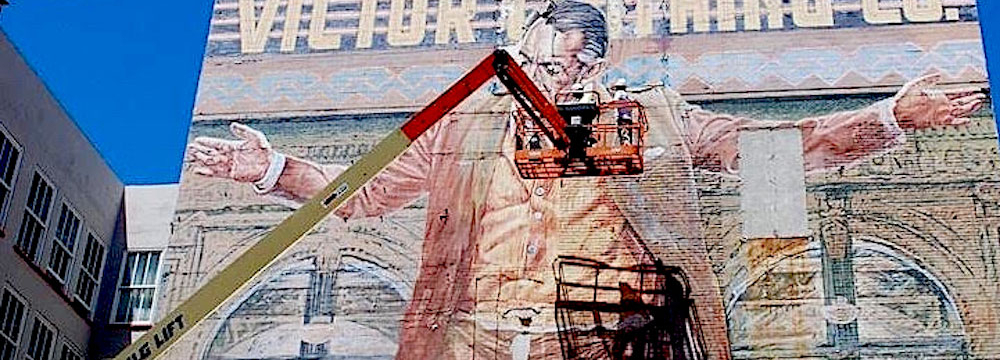
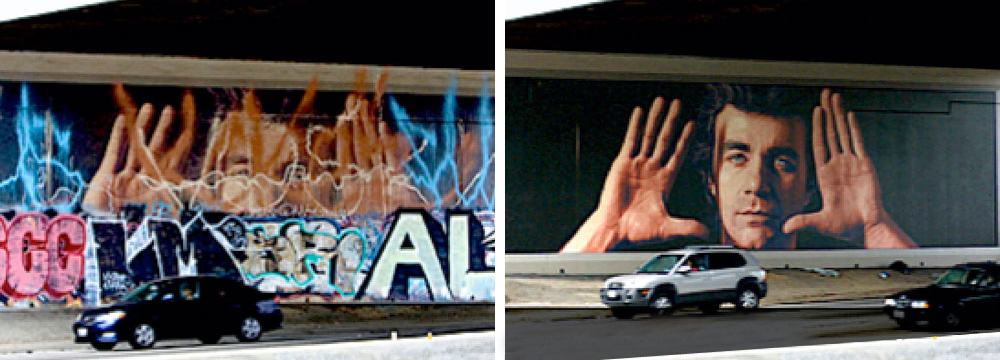
You Are The Star painted in 1983 by Tom Suriya at Hollywood Bad and Wilcox
Case in point which may hit home if you have visited Hollywood. Just off Hollywood Boulevard at the intersection of Wilcox, there is a famous painting called “You Are The Star.” Millions of people have taken selfies in front of this mural depicting old Hollywood movie stars sitting in theater seats looking at you as if you were on stage or on the screen.
Unfortunately, to be accessible for the selfies it’s located directly on the level of the sidewalk, so all kinds of dingdong vandals are able to tag it. It is now covered with graffiti and is unidentifiable.
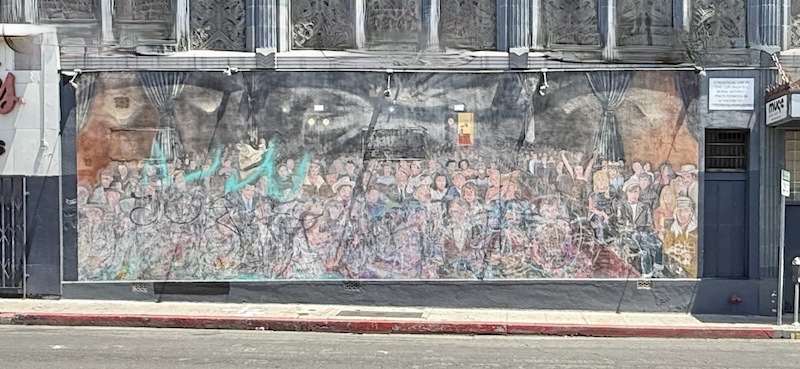
Screenshot
Last month, some head-strong marketing person with her own agenda printed a copy of the mural and then covered the actual mural with the copy. There was quite an uproar in the community because it happened overnight without oversight or authorization.
I was called up immediately to comment on the “restoration” and looking at photographs, I was able to tell that it had been covered over with a print. The print was taken down within 24 hours. In the meantime, the artist was preparing to file a lawsuit according to the reputation protection offered by V.A.R.A and the community was offended with the counterfeit effort to mask over the graffiti instead of properly removing the graffiti and bringing the mural back to life one of the most popular pieces of public art in Hollywood.
That is the difference. Reproduction covers the original. Restoration recovers it.
The value — artist’s reputation, financial and emotional, historical — lives in the original object. A printed overlay, however precise, is a picture of the painting. It is not the painting.
A standing question for any institution that calls this restoration
So far, no museum or collector has stood up and announced they are adopting this method and calling it restoration of an original. The enthusiasm has lived in the marketing departments of the press, not in the institutions. But the technology is new and the headlines are loud for now but… soon you won’t hear any more of it as a “legitimate restoration technique.”
When that day comes, here is my standing question for any museum, gallery, or collector who adopts an overlay like what we are talking about and presents it to the public as a restored work. I will ask it openly, and in print if need be: did you treat the painting, or did you cover it? If the honest answer is that the original is still cracked and lost underneath a printed film, then a reproduction was hung in front of an artwork and the public was told the artwork was healed.
I will defend anyone’s right to display a reproduction. There are good and honest reasons to show the public an approximation of a work too fragile or too damaged to exhibit safely. What I will question, every time, is the right to call that restoration. The word means something. It means the genuine object was recovered and cared for. An institution that blurs that line is not advancing conservation or the public’s education. It is teaching its own visitors to mistake a copy for the real thing, and that is a disservice to the very heritage a museum exists to protect.
Where AI genuinely belongs in conservation
A research consortium involving eleven institutions — including the Art Institute of Chicago, the Victoria and Albert Museum in London, the MUNCH Museum in Oslo, and the National Archaeological Museum in Naples — has been developing AI tools to study how colors in fragile objects have faded and shifted over time. The goal is understanding and documentation: helping researchers and conservators see how a faded textile or a classical sculpture may have originally looked, so that knowledge informs how the real object is cared for. That work is now continuing under a successor project. This is AI used correctly — as an analytical aid that sharpens professional judgment about the original artwork, not as a substitute for treating it.
The distinction is simple. AI as a study tool: legitimate and valuable. AI output printed onto film and laid over a damaged original, then called “restoration” to a public that has no reason to know better: that is where the profession has an obligation to say something. Standards of Practice, Ethics are important for integrity.
Technology changes. The standard does not. Examination, documentation, stabilization, and reversible treatments of the genuine object — performed to professional ethical standards — is what protects a public artwork and the family history riding on your heirloom.
What the press consistently gets wrong about art conservation
This story is not an isolated incident. The confusion between reproduction and restoration is one version of a much older problem: the press covers art conservation the same way it covers magic tricks. Something looks dramatically different at the end, so the headline says it was “transformed,” “brought back to life,” “saved,” or “restored.” The mechanism — the actual professional work that produced the change — gets one sentence, if that, before the story moves on to the before-and-after photograph.
That pattern produces specific, recurring errors that anyone in this profession recognizes immediately.
The word “restoration” is used as a catch-all for anything done to an old object, regardless of whether the original was treated, replaced, reproduced, or simply cleaned. A painting that had a century of yellowed varnish removed — so the original colors became visible again — gets reported as “restored to its former glory.” What actually happened is that nothing was added and nothing was changed; a layer of aged coating was removed and the original painting was already underneath, waiting. That is cleaning. It is important professional work, but it is not restoration in any precise sense, and blurring those words trains the public to have wrong expectations about what conservation involves and costs.
The word “expert” is applied to anyone who touches an object, regardless of training, credentials, or professional standing. A hobbyist with a YouTube channel and a tube of paint gets the same word as a conservator with decades of documented institutional work, peer-reviewed publications, and a track record of reversible treatments on nationally significant public art. The credential gap is enormous. The headline does not mention it.
Speed is reported as an unqualified virtue. “Restored in three hours” is presented as straightforwardly better than “restored over nine months.” In professional conservation, the pace of a treatment is determined by what the object requires, not by what is convenient or impressive to announce. Consolidating actively flaking paint on a mural painted in lead white adhesive takes the time it takes. Cutting that time means cutting corners, and corners cut on a fifteenth-century panel painting are not recoverable. The press treats speed as proof of advancement. Professionals treat it as a variable to be managed carefully.
The before-and-after photograph drives almost all coverage, which means the coverage selects for treatments that produce dramatic visual change. The most important conservation work — stabilizing a structurally failing support, removing a toxic lead-based adhesive that is destroying a canvas from behind, documentation that ensures a work can be treated correctly by conservators a hundred years from now — produces little or no visible change at the surface. It rarely gets covered. What gets covered is the striking image, and the striking image is almost always a reproduction, a digital rendering, or a cleaning that removed something rather than a treatment that preserved something.
The practical cost of all this is real. Clients arrive with expectations shaped by press coverage rather than professional reality. They have read that AI can restore a painting in an afternoon, that a specialist can fix a tear in a single session, that technology has made the slow and careful work of the past obsolete.
When they are told that stabilizing a fragile panel will take weeks and cannot be rushed, that the damage they are seeing required specific materials that are not available at a hardware store, that the “expert” they saw online is not credentialed in any recognized professional body, they feel they are being told something strange. They are not. They are being told what the profession actually is, as opposed to what a news cycle made it sound like. Its why people who ask for a per sq. inch estimate for the restoration of their painting from a photo are disappointed.
Fifty-five years of this work have given me a particular view of these patterns. The sensationalism is not malicious. It reflects a genuine gap between what makes a compelling story and what makes a sound treatment. But the gap has widened as the technology has gotten more photogenic, and this MIT story is the most vivid example yet: a printed film overlay with no treatment of the original gets global coverage as a conservation breakthrough, while the painstaking removal of five layers of overpaint from a pre- World War II 1930s mural buried in a city council chamber gets a paragraph in a local paper, if that.
The standard has not changed. The noise around it has. Knowing the difference is worth something, and it is always worth a phone call to find out what your piece actually needs from someone who will tell you the truth about it. Questions? Scott Haskins, Painting Art Conservator 805 570 4140
FAQ Common Questions About AI Art Restoration
What is the difference between reproduction and restoration? Restoration is work performed on your actual artwork to stabilize and recover it. Reproduction is making a copy, and the original stays unchanged. With restoration you keep the real object, cared for. With reproduction you have a picture of it. The history and the value live in the original.
How do I know if someone is offering real treatment or just a cover-up? First of al the tech being announce in the headlines is not available locally. But, its worth asking one question: is the work being done to preserve my original, or is something just being placed or painted over it? A professional art conservation treatment stabilizes and recovers the actual object, documents every step, and keeps every intervention reversible. If the original stays damaged underneath a substitute, that is reproduction — however advanced the technology.
Does reversibility make something a legitimate conservation treatment? Reversibility is one professional standard, and the AI overlay may meets it… of its not stuck on the painting with some gosh-awful industrial adhesive — the varnish on the artwork theoretically would make it easier to remove off of an old oil painting (not an acrylic painting). But reversibility alone does not make something a treatment. A removable copy on top of the original is still a copy on top of the original. Conservation means the original itself was worked on and stabilized, preserved and restored.
I have a damaged painting. What should I actually do? Call before you commit to anything. Tell us what the piece is, how it’s damaged, and what it means to you. We will give you a straight assessment of what it actually needs — cleaning, stabilization, structural repair, or simply better storage — and you’ll understand your real options. The goal is always to preserve the original you already have.
Questions Call Fine Art Conservation Laboratories at (805) 564-3438.
Keywords: Fine Art Conservation Laboratories, FACL, Scott M. Haskins, Virginia Panizzon, art restoration, art conservation, oil painting restoration, oil painting conservation, professional art conservation, AI art restoration, mural conservation, painting reproduction, reversible conservation treatment, overpaint removal, preservation and restoration of art
This blog post was syndicated

This article has been shared on at least 20 additional platforms to be more available to the media experts and the public seeking answers to questions on professional art conservation. This article shares authoritative real world stories, examples and answers questions from our lab on Ai Art Restoration Related Issues. These placements help ensure that reliable information is available from a well-known professional source.
https://www.expertclick.com/NRWire/Releasedetails.aspx?id=315095